
I know a lot of professionals wonder about the next step in their business analyst career and aren’t sure where to go next. I understand how frustrating it can be when your employer doesn’t have a well-defined career path. Or, your employer might have a well-defined career ladder, but it doesn’t really fit where you want to go.
Either way, it’s up to you to decide what your desired career path looks like, and take the steps required to make it happen.
Business analyst careers don’t just happen. Most often they are the result of focused efforts. In this article, we’ll discuss what the BA career ladder looks like (so you can decide what “next” looks like for you), how to discover what your next step should be, and how to take action to move toward your career goals.
The Business Analyst Success Path Helps You Find Your Next Step
One way to help see the opportunities – or clarify your next step – is through the Business Analyst Success Path.
It’s a framework to help you create your own career path.
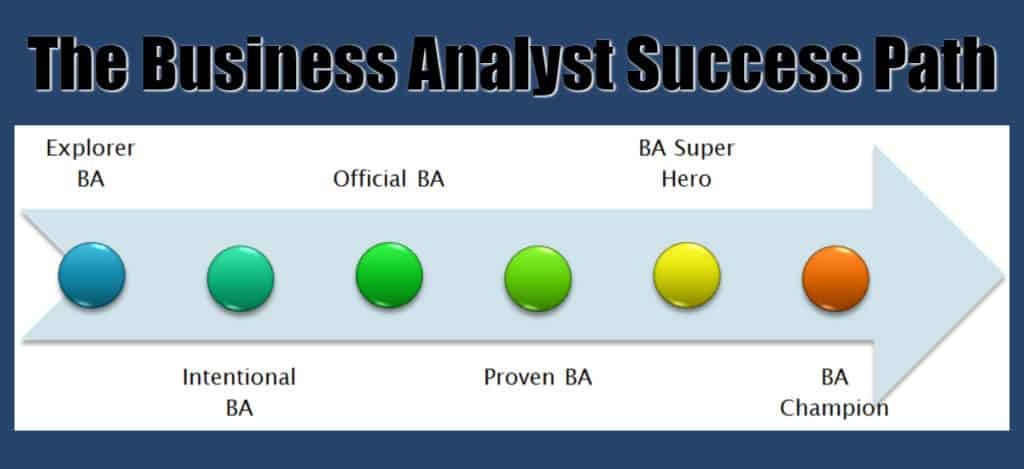
- Explorer BA – You have discovered the profession of business analysis and are considering this as a career path. You haven’t yet made a clear decision to pursue a business analyst career.
- Intentional BA – You have decided that yes, you want to be a business analyst. You start discovering your transferable business analyst skills and learning the core foundational business analyst skills, and consciously expanding your business analyst experience by applying those skills on the job. You seek out your first official business analyst job opportunity.
- Official BA – You are in a formal business analyst role, which may or may not have the business analyst job title. The role gives you more leverage in terms of applying your business analyst skills and the security of being “seen” as a business analyst.
- Proven BA – You have successfully implemented a few projects and gotten consistent results. You trust in your effectiveness as a business analyst and have leveraged a wide variety of business analyst techniques, as well as been involved in the majority of the steps of the business analysis process framework. You have experience to speak to in interviews, but your experience at this point may be limited to one domain or type of project. You can expand your confidence and career through lateral career moves.
- BA Super Hero – You get from Proven to Super Hero by working in new domains and types of projects. As you do this, you stretch your skills and rely more on your BA skills, and less on your subject matter or technical expertise. One great thing about being a Super Hero is that they have a lot of security. Everyone wants them on their projects. A common challenge is that because you are the go-to person, everyone wants you on their project, which can lead to overwhelm.
- BA Champion – While the Super Hero is individually successful, the BA Champion is able to help others be successful. This can be through a variety of different roles, including BA leadership, mentoring, teaching, coaching, and management. At this stage, you may also be looking at setting up BA practices and improving how BA happens in your organization.
Many Business Analyst Career Paths Involve Hybrid or Specialized Roles
One thing I want to note is that many business analysts are in hybrid roles, which means that they are doing business analysis + another role, like testing or project management. It’s also incredibly common to see business analyst roles requiring specialized skill sets, such as an area of expertise in an industry domain like insurance or finance, business application like Salesforce or ServiceNow, or specific methodology like agile business analysis.
While the core business analysis skills are always foundational to your success, these different varieties of business analyst roles also require specialized or additional skill sets. (To get a good understanding of those core skills, be sure to check out our absolutely free workshop – Quick Start to Success as a Business Analyst.)
Deciding to specialize has a big impact on your business analyst career path, as your career trajectory will be connected to the value of your specialization. But, again, your foundational business analyst skills will always enable you to succeed in different types of business analyst roles.
There are many career paths into, within, and beyond business analysis. One common mistake I see business analysts make is to get stuck looking at external circumstances and chasing the latest trends without understanding what they actually want out of their careers.
What Should Your Business Analyst Career Path Be?
The challenging part about building a business analyst career path is that there is no one path “up” for business analysts. Today’s analysts are often blazing career development trails that future business analysts might choose to follow.
If there is no clear path, which way do you head?
- First things first, focus on the core business analyst skills required for new and intermediate business analysts and solidify yourself as a solid contributor in the role. We can help you with this in The Business Analyst Blueprint® certification program, where you can earn your Applied Certification in Business Analysis™ (ACBA).
- Then determine where you are on The Business Analyst Success Path, and decide if the next stage on the success path defines where you want to go in your career.
- Get clear on what you want out of your career. What’s important to you in terms of your salary, role, types of projects, work setting, etc? Go deep and explore all the opportunities available to you, in particular the many senior-level business analyst roles.
- Take action. Do one thing that moves your career forward today and sets you up for more success tomorrow. With that one action, you’ll learn a lot and be even better prepared for more actions in the future.
>> Find Your Next Step – Join the Free Quick Start Workshop

When you join our free workshop, Quick Start to Success as a Business Analyst, you’ll explore the exciting opportunities available to you as a business analyst and bust through the most common myths that hold so many back from success. You’ll discover more about The Business Analyst Success path, how to leverage the business analysis process framework to move your career forward, and address a variety of other common business analyst career questions.
Click here to receive the free workshop
