Business analysis is a high-potential career with a growing number of opportunities and a competitive salary.
You’ll see a lot of advice saying that you need to go back to school, get a degree, and wait years to move into your first business analyst role. In my experience, that’s just not the case.
What is true is that you need to:
- Understand the role
- Identify your transferable skills and experience
- Expand your skill set, with high-impact, practical, real-world training
- Expand your experience by doing business analysis, in your current role of a volunteer setting
- Focus on the best opportunities given your unique experience and career background
I’ll Help You Become a Business Analyst
I’m Laura Brandenburg, the author of How to Start a Business Analyst Career – the career guide that’s helped thousands of mid-career professionals break into their first business analyst role.
I’m going to share everything I can with you about how to become a business analyst in this article, with links to all kinds of related resources and video trainings for more in-depth information. It’s truly the ultimate guide to becoming a business analyst – even if you have no official work experience as a business analyst and an unrelated degree.
But in all transparency, if this is your career path, you’ll want to pick up a copy of my book to go even more in-depth with more practical strategies and approaches.
This is an in-depth article. For a quick overview of these strategies, check out this video to get yourself started – and then come back to watch more of the video trainings below.
Before I forget, I want to be sure you know about my Quick Start to Success free workshop, that’s designed to help you, the mid-career professional, kick-start your business analysis career.
With that out of the way, onward with the 5 steps!
Step 1 to Becoming a Business Analyst – Learn about Business Analysis and Confirm Your Career Choice
If you want to become a business analyst, you need to understand the role. There is a lot of confusion about the role, and business analyst job titles are used inconsistently.
Business analysts are professionals who help organizations identify and solve problems. They analyze data and use various tools and methodologies to identify areas for improvement and to make recommendations for changes. At Bridging the Gap, we provide online business analyst training for business analysts who literally “bridge the gap” between business and technology stakeholders. This means they help ensure that the software solutions actually do what the business needs them to do and solve real business problems.
Understand the Techniques Business Analysts Use
A business analyst doing this kind of work would use a technique like business process analysis to understand that business workflow and the problem to be solved. They would use use cases, wireframes, and user stories to analyze and define the software or functional requirements.
They would also use a variety of data modeling techniques to define how information is stored and flows through all the various software systems. This type of business analyst starts out a project by defining the needs or outcomes, takes it through to scope, defining the detailed requirements and collaborating with the business and technology teams to ensure a successful implementation of the requirements.
Here’s a video with an overview of the foundational skills necessary to be a business analyst.
Before Becoming a Business Analyst, Be Sure the Role is a Good Fit
Before pursuing this role, you really want to be sure it’s going to be a good fit. Check out 42 Reasons to Start a Business Analyst Career and The First 5 Signs that Business Analysis is the Career Choice for You for some clarity on whether or not you’ve found the right role for you.
Even if these checklists confirm you are on the right track, you might still not be 100% sure. A second and more concrete litmus test is to practice some BA techniques to get a feel for the role. We’ll speak to this specifically in Step 4, so keep please reading.
Step 2 to Becoming a Business Analyst – Identify Your Transferable Skills and Leverage Points to Develop Your Positioning
There are relatively few entry-level business analyst roles, and they only make sense to focus on if you are a recent college grad. (I cover this more fully in the FAQ.)
As a mid-career professional, you’ll be focusing on mid-level, and sometimes even senior-level business analyst roles.
Here’s the good news – You most likely qualify for a subset of BA jobs already. (Don’t be frustrated by only qualifying for a subset – even the most experienced BAs do not qualify for all BA jobs.) Many professionals we work with are able to skip right past entry-level BA positions by identifying their transferable skills and the unique qualifications from their career backgrounds. You may also be able to open up opportunities within a slice of business analysis or in a transitional role.
Yes, You Have Transferable Business Analysis Skills!
Transferable skills come from experiences using business analysis techniques in a non-BA role. And here, I share 3 real examples of transferable skills.
Whether or not you have a deep career history in business analysis, it’s likely that one or more elements of your career history give you expertise to leverage into business analysis. Whether it’s your knock-your-socks off communication skills or your deep experience in a relevant industry domain, you have a quality that potential managers are specifically hiring for.
If you are currently employed in a company that employs BAs, then your most valuable leverage point very well could be knowledge of that individual organization, the business model, and the business stakeholders.
(You might be thinking this step doesn’t apply to you. I’ve worked with many, many mid-career professionals on their career transition plans and we’ve always been able to find at least one transferable skill and career experience. More often, we’ve discovered several transferable skills and relevant experiences.)
And Don’t Overlook Unique Skills That Set You Apart!
But your business analysis experience alone often won’t qualify you for a specific business analyst role.
Other factors can include:
- Industry domain experience (Read about how industry expertise can impact your job search)
- Application expertise (Read about how system knowledge helped me qualify for my first BA position)
- Expertise in a specific process area, such as HR or finance
- Expertise in a broad set of functional areas or a broad collection of organizations
All of these can be leverage points, or ways to focus your job search, that give you more opportunities to get started in a business analyst role sooner rather than later.
After discovering your transferable skills and leverage points, this is a good time to update your business analyst resume to showcase how your past experience qualifies you for roles within or close to business analysis.
Step 3 to Becoming a Business Analyst– Invest in Your Business Analysis Skill Set
as part of preparing for a career as a business analyst, you’ll need to invest in developing your business analysis skill set. While a formal degree in business analysis is most certainly not required, some professional training will help you perform business analysis responsibilities effectively.
At Bridging the Gap, we offer online business analyst training in the foundational skills you need to be successful as a business analyst. We organize the BA skill set into a visual model we call The Business Analyst Blueprint®.
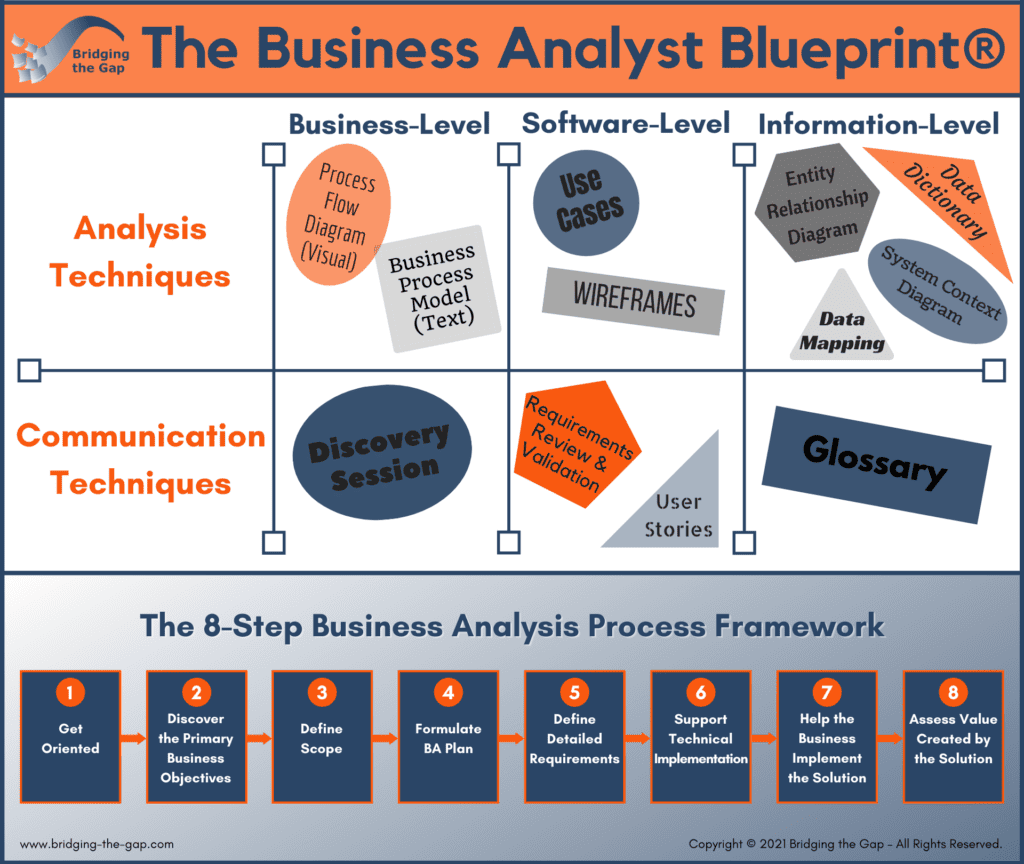
Analysis & Communication Techniques are Both Key Sets of Business Analyst Skills
The first thing you’ll notice about The Business Analyst Blueprint® framework is that the techniques are organized into Analysis Techniques and Communication Techniques. The Analysis Techniques are the models and templates we use as business analysts to analyze and think through the requirements. But these requirements do not get created in a vacuum. We must elicit or discover them from our stakeholders. This is why knowing the right Communication Techniques to use as a business analyst are equally important.
The key Communication Techniques for collaborating with stakeholders are:
- Discovery Session – to discover information related to the process or requirements from business stakeholders, so the requirements represent their needs.
- Requirements Review Session – to validate the requirements that have been captured are clear and correct.
We also consider the glossary and user stories to be communication techniques, because their primary purpose is to capture and communicate requirements-related information to various stakeholder groups.
The Key Business Analysis Techniques
The second thing you’ll notice about The Business Analyst Blueprint is that there is not just one set of analysis techniques. One of the challenges that plague way too many projects is “missing requirements.” We miss requirements either when we don’t involve the right stakeholders (i.e., apply the right communication skills) or overlook key areas of requirements because we are only looking at one view.
The Business Analyst Blueprint® – our flagship business analyst training program – walks you the 3 key levels of analysis that are important to fully understanding a problem and solution domain, when software is being implemented as part of the solution. These are:
- The Business-Level, or how the business work flows operationally, often completed by analyzing the business process (a textual model) and creating business process maps (a visual model).
- The Software-Level, or how the software system supports the business workflows, often completed through functional requirements models like use cases and wireframes.
- The Information-Level, or how data and information are stored and maintained by an organization, completed by data modeling techniques including an entity relationship diagram (ERD), data dictionary, data map, and system context diagram.
When you use multiple techniques, particularly powerful analytical and visual models, you will find that you naturally see gaps that others gloss over and identify the downstream impact of a change or new solution.

The Business Analysis Process Framework
The third thing you’ll notice about The business Analyst Blueprint is that there is a foundational framework underlying the techniques. This is the business analysis process, or the end-to-end approach you apply to be successful and effective on a typical business process improvement and software project.
As you leverage this process framework, you’ll gain increased recognition for the value of business analysis, and you’ll start to get pulled into more interesting projects, and be engaged earlier in the process. Here’s a video about the business analysis process framework.
And, to complete a self-assessment against these skills, we have an absolutely free business analyst skills assessment for you.
Download the FREE Business Analyst Skills Assessment

In this FREE assessment, you will:
- Discover the essential skills to succeed as a BA.
- Gain clarity on your strengths and transferable skills.
- Define an action plan to expand your business analyst skill set.
>> Download the Assessment <<
Step 4 to Becoming a Business Analyst– Build Experience By Approaching Your Work with a BA Mindset
As part of the analysis you did in steps 2 and 3, you may have discovered some gaps. Add these to your professional development plan and explore opportunities to fill them through volunteer positions or by building on-the-job business analyst experiences. What we see is that one business analysis task tends to lead to another, creating a virtuous cycle of new business opportunities and expanded experience.
Practice techniques such as:
- improving a business process
- facilitating meetings
- crafting use cases
- scoping projects with these 5 questions
- eliciting information
How One Business Analyst Experience Leads to Another
As you a cultivate a BA mindset, you’ll find that business analysis begets business analysis. Once you see your first opportunity, several more sprout up right in front of you. Is a virtuous circle that can lead you to a full-fledged business analysis role, step-by-step.
Want some inspiration? Here are a few success stories of participants who built BA experience in non-BA roles:
- Amelia McHenry transitions from Technical Writer to Business Analyst
- Zineb Iotti transitions from Underwriting to Business Analyst
- Roshni Dominic transitions from Support Analyst to Business Analyst
- Becky Goll volunteered for a CPA to build business analysis experience
- Todd Fleming landed paid contract work by volunteering with his old employer!
When in doubt, it almost always makes sense to start by analyzing a business process. Here’s a video tutorial on this essential business analyst skill:
Step 5 to Becoming a Business Analyst – Focus Your Efforts to Find Your First BA Opportunity
In time, you may qualify for a business analysis role in your organization or be in a position to propose a business analyst role in your firm.
But not all job situations provide the same opportunities. Some BAs find themselves looking outside their organization for their first BA jobs. If that’s you, you’ll want to read more about our business analyst job search process.
Showcase Your Business Analyst Skills in Your Resume
You’ll want to prepare a business analyst resume, that highlights your transferable business analysis skills and career experiences.
Prepare for the BA Job Interview
Prepare for business analyst job interviews by being ready to share specific stories and examples related to your business analysis work experience. I share more about how to do this – even if you’ve never held the BA title and have no “official” BA experience in this video:
Be Open to Transitional Opportunities on Your Path to Becoming a Business Analyst
And if your transferable skills assessment came up a bit short, you may need to explore a transitional role to lead you on the path to BA. Focus on roles where you are working on projects or interacting with business analysts in some way. Start to build up more transferable business analysis skills, while you expand your business analyst skill set through professional development training opportunities.
Not sure where to start? Here are 13 jobs that can lead to business analysis.
>>Plan Your Next Step to Become a Business Analyst with our Free Workshop
While this is a lot of information, you might be wondering exactly what steps you can take. We offer a free Quick Start to Success workshop that will help you figure out your next step. And before you move on – be sure keep scrolling for answers to the most frequently asked questions we receive about becoming a business analyst.
How to Become a Business Analyst – Frequently Asked Questions
You might be thinking that these steps don’t apply to you because {fill in the blank here}. I’ve corresponded with hundreds of aspiring business analysts as part of my online courses and helped many successfully make this transition (just check out our list of success stories).
What follows is a list of concerns and questions that most commonly come up and how to address them.
How do I become a business analyst if I’m unemployed?
If you are unemployed, focus your efforts on step 2 and use the results of this analysis to update your resume and strengthen your positioning for BA jobs. If you are still not able to qualify for a small slice of business analysis roles and your timeline to find a job is short, refocus your job search on transitional roles. If your timeline is longer, you may consider investing in step 4 as a business analyst volunteer.
How do I become a business analyst if I just graduated from college with a degree in business analysis?
If you are a recent college grad, you can still use these steps. In any given location, there are often a select few organizations that actively recruit recent college graduates into entry-level business analyst roles. Find them and apply!
If you worked through college or actively leveraged internship opportunities, you may have adequate experience to invest some time in step 2 and qualify yourself for a role requiring 2-3 years of experience. (For more information on how this works, read Eric’s transition story – he landed a BA job just 7 months out of college.)
If neither of these options works out for you, consider investing a few years in a transitional role working your way towards a business analysis, particularly focusing on step 4 above, and then working your way back through the 5 steps.
Here’s a full tutorial on starting with an entry-level business analyst role.
How do I become a business analyst if I have my MBA?
While it might give you an extra edge in your positioning, but it’s not a silver bullet into business analysis. If you participated in real-world projects as part of your MBA, then analyze those using step 2. And also be sure to heavily leverage the professional network you built during your MBA as part of your job search in step 5.
If you pursued your MBA right after your bachelor’s, refer to my answer above. If you pursued your MBA mid-career, be sure to go through all 5 steps as it’s likely you have a lot of experience to draw from. And ask your employer for opportunities to apply your MBA and build relevant professional experiences (see step 4).
What training do I need to become a business analyst?
Good question. Look for training opportunities that help you build your business analysis skills AND expand your experience and covers the foundational skills in business process analysis, software requirements analysis, data modeling, and an end-to-end approach to a project as a business analyst.
Our flagship offering – The Business Analyst Blueprint® training program – covers all of these skill areas and offers practical, results-oriented content and learning.
You’ll leave the program with instructor-vetted work samples and real-world experience as a business analyst.
How can I become a business analyst if I don’t have IT skills and experience?
You don’t need to be able to code to be a business analyst! If you are going to be a BA on an IT project, you will need a technical understanding, but you don’t need to know how to code or create software.
Here’s a post describing the difference and why we see technical skills in BA jobs.
Here are the technical skills and understanding you do need to be successful as a business analyst, which include:
- The ability to analyze and specify functional/software requirements in use cases and wireframes.
- The ability to model data and specify data requirements
- The ability to ask good questions about what the technology can do and what the business wants it to do.
How can I become a business analyst if I don’t have business domain expertise?
Business domain expertise is a leverage point and many aspiring BAs are very successful at leveraging expertise in a particular domain to find their first BA position. But if you don’t have expertise in a particular domain, it doesn’t mean that you can’t become a BA, it just means that you need to focus on the opportunities where business domain expertise is not such an important qualification.
At times this can feel like looking for a needle in a haystack. But believe me, the opportunities are there. Keep working away at step 4 and putting your feelers out. An opportunity will surface for you.
>> Get Your Quick Start to Success to Become a Business Analyst
Earn the respect you deserve and get the insider details on how to get into a business analyst career quickly, with our free Quick Start to Success training. You’ll learn how to avoid the most common pitfalls faced by new business analysts and the step-by-step business analysis process to create predictable, consistent project success.
> Click here to register for the free training today <<

Hi Laura Brandenburg,
Greetings…!
I have 2.10 years of experience in to HR-Admin,working for an IT company, now i want to change my role hr-admin to Business Analyst.initially what steps i need to take and please guide me on this. I am very interested to work or build my career as BA. I used to interact with clients they suggested me to turn as BA and also i have an interest too. I am a MBA graduate.
Thanks and regards,
Dileep
Would like some mentoring advice pleas
Hello Laura,
Your blog on Business Analyst was wonderful. I have done my Masters of Business Administration and have experince of 4 years as a Accounttant in mid-size firm. Please guide me how to become a BA.
Best Regards.
Aseem Khan
Hi Aseem, Welcome to Bridging the Gap! I suggest starting with our free email course.
https://www.bridging-the-gap.com/free-email-course-for-business-analysts/
Hi Laura! I am interested in becoming a BA. I am from Pakistan. I have done BS in Computer Engineering but i have never been on programming side. I have a 1 year job experience in IT Department of a bank. Provided help-desk and monitored LAN/WAN connectivity of branches.
What do you suggest me?
I have recently graduated from a Business Management Diploma and I have previous degree in Management Information Systems. I have experience with Business Intelligence tool “Cognos”with IBM as a technical analyst, I have done business analysis during my Bsc studies. yet I dnt have a real world experience yet. I have been trying to apply for a junior BA positions, and I am not sure what roles i should be focusing on to gain the neccessary experience to become a BA, any thoughts ?
Hii
Laura
This is kamlesh m pursuing my master degree in marketing management i have been thinking for BA how could i get approached….
Hi Laura,
Greetings!!
I am working as a Business Analyst in Genpact, but I am not sure whether the kind of duties that I perform come under a Business Analyst’s role. I create Business reports for IMS Research using Excel, SQL, PL/SQL, Microstrategy, TOAD etc and send them to the stakeholders, I take requirements from various Stakeholders and then create the reports accordingly. Another part of my job is to QA them by various LEAN measures. Is this different from a ICT Business Analyst profile? If so how can I be one.
Your Suggestion is appreciated.
Regards,
Raj
Yes, Shaktiraj, It does sound like you are fulfilling some business analysis responsibilities, in addition to other roles. You might check out this post on the BA role for more clarification.
https://www.bridging-the-gap.com/what-is-a-business-analyst-role-anyway/
I am a MCA graduate and presently working as a Quality Analyst (not programming) with 1 year 6 months experience. Can you guide me about the step I should take to make my career as BA? Shall I need to learn any relevant courses for the same?
—
Thanks,
Swathi.
Dear Laura,
First let me give my sincere thanks to you for your marvelous book ‘How to start a Business Analyst Career’, Which I grabbed long back but failed to convey my regards to you.
Basically I am a MBA Marketing Professional having 3+ years of rich experience in Business Development /Consulting and Marketing/Sales, in IT as well as Engineering Industries so far.
And currently I am very passionately seeking a career opportunity in the area of Business Analysis.
So now queries are :
1. How I can get the first/entry level dream job in Business Analysis.. As I am a strong mechanical engineering graduate but having experiences in Engineering Software and IT industry.
2. But not having technical exposure in IT like software platforms, Design, Coding, Testing etc.
3. But having basic knowledge about SDLC, Onsite/Offsite Delivery Models, Offshore Models As I am dealing with International Offshore Business Development in my current profile.
4. Are there no any Business Analysis positions for Engineering/ Operations…?? Where my knowledge of Engineering will be worth while, OR for the sake of becoming a BA I have to get used to with IT industry. Is this the only way…??
5. According to your techniques in BOOK, I have drafted my resume with BA Skill sets and related activities, and other side I really can’t see any opportunity with my current employer to transform my profile to BA within the organization. (So only one option – Have to search new BA JoB)
6. According to your suggestions to find relate jobs wit BA, I genuinely not seeking those opportunities either. As I am really willing to get out of this Business Development Profile, Very Desperately.
7. Shall I need to opt for any personal BA training programs but those are very expensive in India, Is this the only way to get a BA Job…? Because I can’t afford this much cost, I have already got your book here which is very costly in India compare to States.
I will be very obliged and thankful to you for your valuable guidance on my future career guidelines.
Look forward your precious reply soon.
Regards,
Kapil
Hi Kapil,
Thank you for purchasing How to Start a BA Career and also your compliments on the book. You’ve taken a great step by drafting your BA resume with the relevant skill sets and related activities. How is your resume being received by potential employers? Are they looking for specific training? Or additional skills? If so, then I would suggest positioning yourself for a transitional role where you meet most of the qualifications as a point on your path to BA.
You ask if there are BA positions within Engineering or Operations, I would say yes. They may have a different title, but I would imagine that the competencies of a BA would be very relevant in these industries.
Hello Laura,
Thanks a lot for your precious reply.
I understand from your writing that i need to search for Transitional role on the path of BA.
As far as the responses are concerned i am getting numerous responses but all are related with my current domain i.e Business Development, Nevertheless i have cleared through my Career objective that I am looking for entry or associate level BA role.
In order to answer your raised questions i would say, They are not looking for specific training or additional skills, The priority is, You should have pre- experience in BA. i wondered how one could get a experience with out working in the respective domain.
I am concentrating on entry level positions but seems difficult to get, even calls for the interviews too.
Look forward your thoughts.
Regards,
Kapil
Kapil,
If you are still getting calls for business development jobs, then my guess is that your resume is positioned highlighting those experiences. I’d go back to your resume and try to position yourself more strongly as a business analyst. Your past experience can count, if you can reposition it as BA experience.
There are some posts here about resumes:
https://www.bridging-the-gap.com/how-to-find-a-business-analyst-job/
Hi Laura
Does BA need to have IT background? I just finished BA training, but I don’t know how to get a BA job. I have MBA and HR degrees, what kind of BA I can be?
Thanks,
Vivian
Hi Vivian, You don’t need an IT background. Plenty successful BAs today do not have a background in IT, myself included. This post helps explain that:
https://www.bridging-the-gap.com/help-a-ba-how-do-become-a-ba-if-i-dont-have-an-it-background/
There are many types of BA roles. You might leverage your expertise in HR to get started, as domain experience can often help new BAs get started in the profession. Check out this post on industry experience for some context on that factor:
https://www.bridging-the-gap.com/how-industry-expertise-can-impact-your-business-analyst-job-search/
Hope this helps! Would love to add your story to our Registry of BA Career Transitions by the end of 2012!
https://www.bridging-the-gap.com/bridging-the-gap-registry-of-business-analyst-career-transitions/
I am a PhD (Bioinformatics) and presently working as a Bioinformatics consultant. I want to be a BA, as my training has provided me knowledge of IT as well as molecular-biology. Can you guide me about the step I should take to make my career as BA?
Thanks
Hi Rohita,
Thanks for your comment. I have sent you a direct reply via email.
Pingback: Help A BA! How Do I Find a Mentor? | The Agile Radar
Pingback: How to Become A Business Analyst? « QTheBA
Well done, I read it two times
Hi Shwetal,
An IT Background is not necessary – check this post. Many, many BAs have done it.
https://www.bridging-the-gap.com/how-to-become-a-business-analyst-when-you-have-an-it-background/
CBAP certification is for Senior BAs with 5 years of documented BA experience. It is not a necessary qualification to start the profession and is not typical because of the experience requirements.
And if it helps, I have never done coding either! I came from a technical background, but in QA. This required a bit of technical knowledge but no coding. So I know first-hand this is possible.
In terms of career background there’s not much that’s going to hold you back from becoming a BA. It’s more important that you have the passion for it and are a strong communicator. The rest you can learn and build as part of your career path.
I also forgot to mention my free email course on becoming a BA which should help you a lot!
https://www.bridging-the-gap.com/enewsletter-sign-up/become-a-business-analyst-free-course/
Thanks Laura ,
That was quite motivating. I have subsrcibed for the news letter and the free email course.
Hello Laura
This was one of the most informative blog for me on Business Analysis. I really liked this website Bridging the gap.
I am working as a Analyst with Bank of America Merill Lynch . My Area of operation in IT is Prime Brokerage . I support Applications that come in Prime brokerage . I have not done coding . I used to do it in my college days. However i want to become a BA . I have done interaction with business for over a period of more than 5 years. And many times understood there issues and translated them in the form of a problem to developers for a fix. And development has done that for me and business as well. Could you please help if this suits as my skill for becoming a BA ? I would like to interact further on this.
Thanks for your positive feedback Shwetal! It does sound like you have done some BA like activities or at least that your prior experience as a translator will suit you well as you move into BA. I might suggest you focus on step 1 and 2 – learn more about BA and then identify your transferable experiences.
To interact further on this, check out Launching Your BA Career: http://www.mybusinessanalysiscareer.com/landing/launch-your-business-analysis-career/ or our BA Mentoring Program: https://www.bridging-the-gap.com/business-analyst-career-mentor/
Thanks Laura , i will definitely take a step to that . However , i have a question in regards to CBAP certification . Is that something mandatory if i want to move on to a BA role ?
Also as i said earlier i have not done coding . I hope it doesnt becomes a negative point on my side .I actually dont mind going in the direction of becoming a business side BA . Is it a good idea please let me know your views on it ?
The only one I am having trouble on is step #4, Building My Personalized Roadmap. I really could use more info on this. It sounds easy enough, but it’s not. Any tips would be appreciated. Thanks!
Kristi,
Are you having trouble setting your career goal or crafting a plan to achieve it? If a plan, what’s your career goal?
Thanks, Sudhi. Welcome to the band wagon!
Pingback: Tweets that mention Becoming a business analyst -- Topsy.com
Truly and well said Laura…This article is an eye-opener and self realizing to any person who wants to jump to the band wagon of ‘Business Analyst’.!!