
On every successful project, you’ll find a business analyst.
They may not have the business analyst job title, and they may not even be aware they are doing business analysis work, but someone is ensuring the right problem is being solved, that everyone understands the problem and solution in detail and is on the same page about what the software is going to do, and how that achieves the business objectives.
So what is a business analyst? And what does a business analyst do?
There are many variations of the business analyst role, and the business analyst job title is used inconsistently. Here at Bridging the Gap, we focus on how the practice of business analysis unfolds specifically on software projects, where the business analyst is responsible for ensuring the team is solving the right business problem and guiding the team in analysis and communication activities that get all business and technical stakeholders on the same page about the project scope, including the business and technical aspects of the solution.
Whether your team is leveraging agile software development practices or more traditional ones, effective business analysis is essential to success. If you are interested in starting, succeeding, or excelling in a business analyst role, this article is your guide to the role, responsibilities, job description, and mindset of a business analyst.

Defining The Business Analyst Role and Mindset
Out of chaos, we create order.
Out of disagreement, we create alignment.
Out of ambiguity, we create clarity.
But most of all, we create positive change for the organizations we serve.
Business analysts lead teams from the inside out. We create positive change for our organizations. We inspire others to follow us on our path toward positive change. We help everyone understand exactly what that change is and how they can contribute to it. We help teams discover what the change should be.
Source: Bridging the Gap’s Business Analyst Manifesto.
In essence, if you’ve helped teams focus on alignment, clarity, and positive change, you are filling the essentials of a business analyst role and have the mindset of a business analyst. It’s not uncommon for an aspiring business analyst to discover they’ve been doing BA work intuitively for years. They are able to uncover many transferable business analyst skills and position themselves for mid-level and, depending on their experience, even senior business analyst roles.
A Dedicated Business Analyst Role Sets Projects Up for Success
Having a dedicated business analyst role on your project has a tremendous ROI (Return on Investment). As high-performing business analysts, we need to be aware of the value we create, and how we contribute to the ROI of a project. The role is still misunderstood by many, and we’ll often find ourselves needing to educate our leadership and stakeholders about how we can make a contribution.
Business analysts add value by:
- Reducing rework that’s caused by overlooking requirements until late in the development process.
- Reducing requirements churn, or the time investment from stakeholders in getting clear on what they want out of a software solution.
- Finding more cost-effective solutions, whether that’s simplifying the requirements or finding non-technical solutions to business problems.
- Discovering new business benefits that increase the ROI on the planned project investment.
- Prioritizing requirements, so the development team has a clear idea of what to implement first.
- Facilitating communication with the business community, so the delivered solution is used as intended.
- Providing a framework for IT to scale, particularly as an organization grows beyond the boundaries of informal communication where everyone knows everything about the business.
Here’s a video walking you through the value proposition of business analysis:
>>Plan Your Next Step with a Free Workshop
 While this is a lot of information, you might be wondering exactly what steps you can take. We offer a free Quick Start to Success workshop that will help you figure out your next step.
Click here to learn more about how to start your BA career
The Key Responsibilities of a Business Analyst
To contribute this level of value, you need to bring a structured framework or approach to the business analyst role. This role includes taking the requirements aspect of the project from initial problem or idea to a fully implemented solution. The following business analysis process supports the business analyst in navigating a project effectively and successfully.
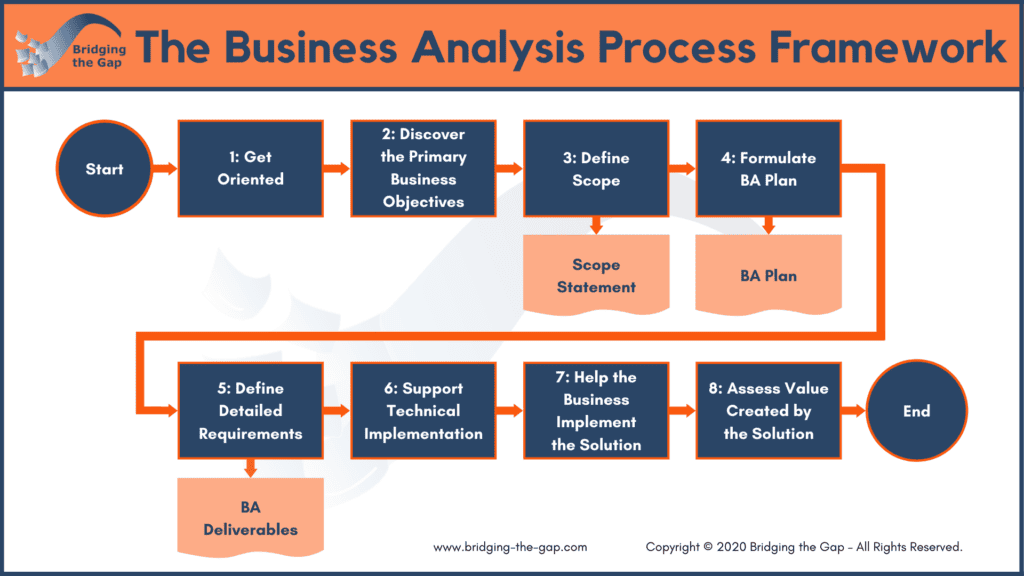
This is the 8-step business analysis process framework we teach at Bridging the Gap, and it’s helped thousands of business analysts be more effective in their role. Let’s take a quick look at the business analyst responsibilities involved in each step.
- Get Oriented – Start actively contributing as quickly as possible by managing expectations and conducting preliminary stakeholder analysis.
- Discover the Primary Business Objectives– Ensure the right business need or problem is solved, and that all stakeholders are aligned on the expected outcome.
- Define Solution Scope– After exploring multiple possible solutions, gain agreement from stakeholders on the scope of the solution to be developed, and ensure it fits within the constraints of the project.
- Formulate Your Business Analysis Plan– Identify what types of documentation or deliverables to create, and what needs to be done when. Ensure stakeholders understand what contributions they need to make as part of the project, as business analysis never happens in a vaccum.
- Define the Detailed Requirements– Gain alignment and clarity at a detailed level, so that both business and technical stakeholders can successfully implement the solution. This involves developing a consistent method of communication so that all stakeholders know and understand the requirements.
- Support the Technical Implementation– Be a partner with the tech team and ensure they have everything they need to be successful, and explore opportunities to generate even more business value from the software aspect of the solution.
- Help the Business Implement the Solution– Support business stakeholders during implementation, user acceptance testing, and roll out so that they ultimately get what they need and are able to incorporate the delivered solution into their day-to-day work.
- Assess the Value Created by the Solution– Assess the Return on Investment (ROI) of the solution, celebrate the project successes, and identify new opportunities to improve the business.
You can learn more about the 8-step business analysis process framework in this video:
And, yes, this process framework applies in agile too! Here’s a guide to how to leverage this framework to be a successful agile business analyst.
Key Skills for Success in a Business Analyst Role
The business analyst role requires both hard and soft skills. Business analysts need to be able to gain alignment from diverse sets of stakeholders on both the big picture and the granular details of the project.
First, there are core, underlying skills that set you up to be a great business analyst, such as:
- Communication skills – Verbal and written communication skills are extremely important, as is the ability to facilitate meetings with diverse sets of stakeholders.
- Problem-solving skills – The ability to understand what problem is being solved and why, as well as navigate new challenges and problems throughout the project, is essential.
- Critical thinking skills – Business analysts evaluate multiple solution options and provide critical thinking to back-up or probe into stakeholder assumptions.
Then there are specific business analysis skills in analysis and communication. To be successful as a business analyst, you need a toolbox and a framework.
- A TOOLBOX of techniques that you can pick and choose from, based on the needs of your project and team.
- A FRAMEWORK that guides you step-by-step what to when.
At Bridging the Gap, we provide an organized, streamlined, and practical toolbox and framework in the form of The Business Analyst Blueprint® – it’s both a framework for approaching business analysis skill development and the name of our flagship, online, practical training program.
And it looks like this:
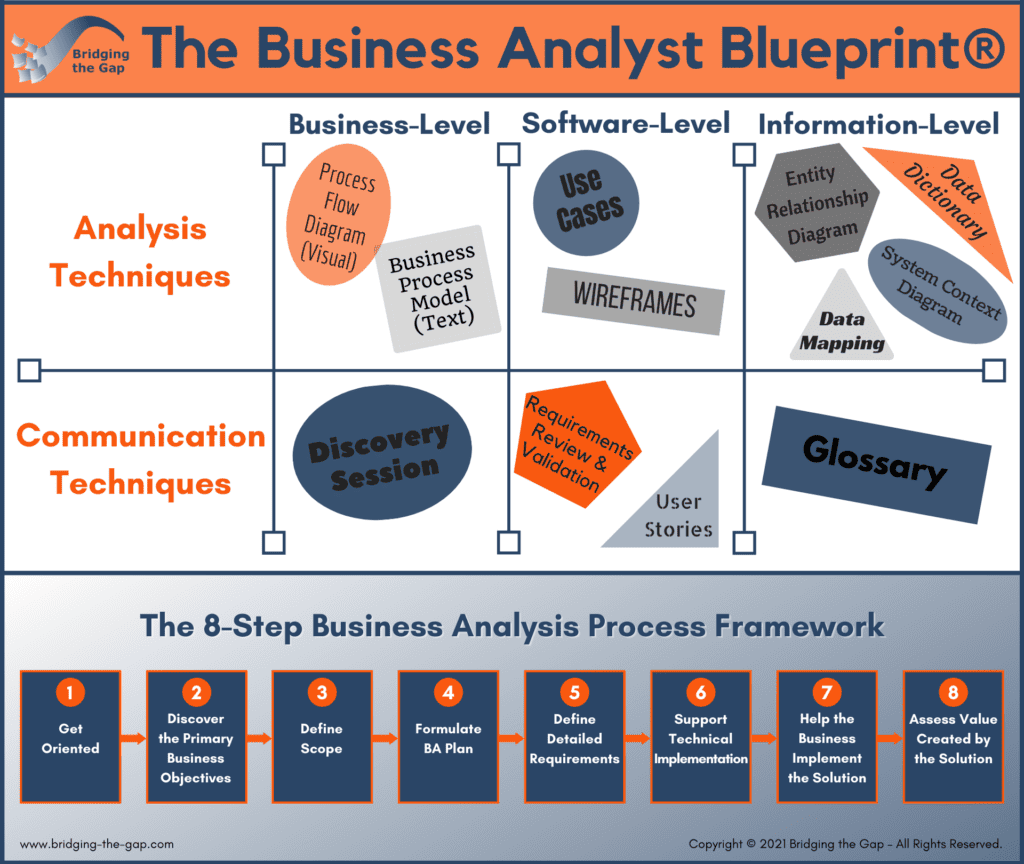
While we already talked about the end-to-end framework. :et’s take a deeper look at the toolbox of techniques a business analyst needs to succeed in their role.
- The Business-Level, or how the business work flows operationally, often completed by analyzing the business process (a textual model) and creating business process flow diagrams (a visual model).
- The Software-Level, or how the software system supports the business workflows, often completed through functional requirements models like use cases and wireframes.
- The Information-Level, or how data and information are stored and maintained by an organization, completed by data modeling techniques including an entity relationship diagram (ERD), data dictionary, data map, and system context diagram.
When you use multiple techniques, particularly powerful analytical and visual models, you will find that you naturally see gaps that others gloss over and identify the downstream impact of a change or new solution.
Here’s a video that walks you through the key business analyst skills.
The Typical Day of a Business Analyst – Or, What Does a Business Analyst Actually Do?
The role is so varied that there really is no typical day for a business analyst. And that’s one of the things many business analysts love about the role, as there is a lot of variety in the work.
I have an entire video on this topic, but here are a few things I’ll share here about the role:
- There tends to be a split between independent and stakeholder-facing work. It can vary from 50/50 to 70/30 in either direction. You want to be sure that you’ll enjoy interacting with people as well as doing independent analysis and critical thinking work.
- Business analysis is a self-managing role. You need to be proactively thinking ahead and planning out your process to ensure nothing slips through the cracks.
- The days tend to be different depending on what type of project(s) you are on and what phase they are in. Early on, you’ll be doing a lot more discovery. Then you’ll be in the details and analysis process. Then you may be supporting the business and technology teams during development and implementation.
- It’s quite possible you’ll be working on more than one project at once! So be ready to be in all the phases at any given time.
And here’s the video with a lot more detail on what to expect day-to-day:
Business Analyst Roles Can Vary Widely
While these are the essential skills and responsibilities of a business analyst role on a software project, roles and titles vary widely. Depending on the role, the BA professional may also take on more senior-level business analysis responsibilities, such as such as strategic analysis, learning new domains, and project portfolio management.
The definition of business analysis allows for many different approaches to the role.
- It brings in professionals who work on software projects, business process changes, logistics, or ensuring compliance with regulations.
- It brings in professionals who work on projects focused on integrating multiple software systems, building new software systems, and modifying existing software systems, or migrating from one software system to another.
- Sometimes specific industry expertise or expertise in a specific business application is required to be successful. Pick any attribute of a project, organization, or stakeholder group — oftentimes the business analyst role in that context is shaped around multiple attributes.
When reviewing business analyst job descriptions, pay attention to both the generalized aspects of the role that are common across many roles and the specialized skill sets that pop up in a specific roles.
Hybrid Business Analyst Roles Are Incredibly Common
What’s more, it’s common for a specific business analyst role to be a hybrid business analyst role, meaning that you will have responsibilities beyond the core of business analysis.
Common hybrid roles include:
- Business Analyst / Software Tester
- Business Analyst / Project Manager
- Business Analyst / Product Manager
- Business Analyst / Software Developer
Because business analyst job titles are used inconsistently, it’s not uncommon for these hybrid roles to be under the title of “Business Analyst”. It’s also not uncommon for a role like Project Manager or Software Developer to simply include business analyst responsibilities.
In fact, there are dozens of different business analyst job titles. You can learn more about the difference between the BA job title and the BA role here:
The Difference Between Business Analysis and Related Roles
What’s more, there are many roles that are closely related to business analysis, or leverage business analysis skills to be successful. Here are articles in which we dive into the difference business analysis and other, similar, roles:
- The Difference Between a Systems Analyst and a Business Analyst
- The Difference Between a Product Manager and a Business Analyst
- The Difference Between a Subject Matter Expert and a Business Analyst
- The Interplay of Project Management and Business Analysis
- The Difference Between Business Intelligence and Business Analysis Roles
How to Become a Business Analyst
Business analyst roles generally favor on-the-job work experience. And it is definitely possible for a mid-career professional with work experience to start a business analyst career.
- First, learn about the business analysis career and confirm your career choice. Exploring the resources in this article is a great place to start!
- Second, identify your transferable business analyst skills – these will enable you to skip right past entry-level BA positions.
- Third, invest in your foundational business analysis skill set. Here at Bridging the Gap, we provide online business analysis training opportunities that help professionals start, succeed, and excel in their business analyst careers.
- Fourth, build on-the-job business analysis work experience by approaching your current work with a BA mindset. For example, no matter your role, you can always improve a business process.
- Fifth, focus your efforts to find your first BA opportunity. Leverage your areas of expertise and experience in related roles to focus on the opportunities that will be easiest to qualify for. Then you can expand your skill set and experience, opening up even more opportunities.
In short – if you truly want to become a business analyst, it’s certainly possible! And the career opportunities within business analysis make this an exciting time to pursue a business analyst role.
>>How to Learn the Foundational Business Analyst Skills
When you join The Business Analyst Blueprint® training program, you’ll gain real world experience in the industry-standard techniques and business analysis processes so you can upgrade your skills, bring a fresh perspective to your business analysis approach, and know exactly what to do on your software projects.


@k das, It’s with a digital interactive agency, so marketing is a part of the company’s make-up. Thanks for commenting!
Hello,
Would i join this discussion!. I believe that’s a BA in digital marketing company. Am i right!?
Hi Laura,
I have found your blog to be EXTREMELY helpful to me. I have transition my career from a web developer/digital content manager to a BA (new to the profession). My question is what is the difference between a traditional BA and a Digital Marketing Business Analyst?
Hi Jamala,
Thanks and so glad we can be of help. I’ve never heard of a Digital Marketing Business Analyst, so my guess is that it’s a title used in one or possibly a few companies, likely inconsistently.
Thanks Laura for your clarification and help!
I’m trying to have a BA role introduced at my company, a medium sized organization. Any material you could direct me to on how best to make a successful business case to those who may be unfamiliar with the role would be much appreciated!
Dear all,
It is a very good discussion about the nature of a BA role, but I don’t like the publicity of a role because having an attitude of analyzing or negotiating something is not enough to be a professional BA. Let us diffrenciate between an analytical thinking skills required to do a job wisley and the art and science of a business analysis in many business fields to enable a communication of the problem solving to all parties
For example;
Being very professional in negotiating a supplied quantity for a specific raw material with an external supplier, internal planners and marketer; shipping agent, and after all re-adjusting a forecast with your top-management staff for the finished goods which use this raw material makes your work complete in an excellent way
But we talk about a BA when we talk about the steps you did, esablishing a system to be followed, document it, makes policies and SOPs, convert the procedures to software specifications, or even plan and manage its creation and implementation.
Also, companies need a BA when establishing new business systems which is not a responsibility of a specific area-related guy
For example;
communicating with a comopany’s distributors to set some protocols to get sales data from them-Sales & Marketing responsibility, benfit from it in ajusting replinshment level and speed-Logistics responsibility, esablish a software to store and manipulate these data-IT responsibility, and rolling forecast every month in an S&OP meeting-Top management staff responsibility.
Finally, I hope my perspective helps you in defining a BA role
Thanks & Best Regards,
Ehab Nady
Ehab, Can you be more specific about what “publicity” you are finding?
Dear Laura,
Excuse me I have used the wrong word
I mean by this word that we should not consider a person as a BA because of just he has an analytical thinking skills, which is now an essential skill for most jobs
But there are many other skills and functions for the BA may not be available in other people although they have the skills of analytical thinking
My apologies again for this mistake
Thanks & Best Regards,
Ehab Nady
Thanks for clarifying and no worries. I just wanted to be sure I understand so I could respond appropriately. I do think that having the critical thinking and communication skills and the willingness to problem solve in your work gets you 80% of the way there. No, you may not be a “titled” BA but you definitely have the BA mindset and are doing business analysis.
Hi Laura
I just discovered your site. What a terrific resource!
I just wanted to add a note regarding the BA role vs. the practice of Business Analysis (a distinction touched on by the BABOK quote you began with) – in particular with respect to ‘agile’. Increasingly, I have seen our clients are incorporating agile approaches. One strong principle these clients follow is that there be no intermediary between the IT side and business – so the concept of the BA as an intermediary is completely abandoned. In addition, agile team members tend more to be multi-functional rather than dedicated to one aspect of the project. This does not mean that there is no place for a BA in these shops – but it does change the nature of the role. Firstly, the BA’s purpose in an agile environment is to facilitate communication between the two groups, but this communication happens while both groups are in the room – not with a BA shuttling back and forth between them. Secondly, the role may be ‘virtual’ – not a dedicated person but, instead, someone who practices Business Analysis during a project while also engaged in other activities. (E.g., in Scrum, BA responsibilities are carried out by the Product Owner and an analyst team member.) So – while a formal BA role may not exist in these environments, the practice of business analysis persists and knowledge of BA techniques is still essential.
Thanks Howard! I agree that the BA should not limit themselves to being an intermediary, regardless of the environment. At our best we are helping facilitate conversations between all stakeholders – and on a software project that means business and technical stakeholders. To be a mere intermediary is hopefully becoming ancient history for business analysis.
And yes, anyone who does business analysis is a business analyst, regardless of their job title.
I would like to add an interisting view on the business analyst role. Although it has “business” as part of the name, I think it is important to remind everyone that, besides the business users needs, the solution defined by the business analyst has to fulfill the company support areas users as well. The best solution for the company is the one that meets balance between business users needs and support/operations users needs as well.
Eduardo,
Very good point – this comes back to the work the BA does to analyze the stakeholders and get all the right people involved in the problem-finding and decision-making to ultimately achieve the business objective for the project. We discuss this idea more in this post:
https://www.bridging-the-gap.com/whos-perception-of-value-do-we-care-about/
Hi laura,
This is my first time on bridging the gap.Though i don’t understand much of BA profile,but i would like to confirm my understandings so kindly correct me if i am wrong.
BA’s are the person considering all through about the quality of a product as per the stakeholders and performance concerns acting.
Hi Laura,
I have been going through your blog , and i must confess i am really thrilled, the dedication and vibes here is awesome.
I am relatively new to business analysis and have been trying to get a second contract role ever since Jan, I have been invited to this job interview, and i have been asked to give a 10 min power-point presentation on Friday 15th march.
Just wondering if you guys could through me some hints on this
“As a business analyst, your influence extends across the whole project lifecycle. How can you go above and beyond an analyst role to ensure your project is delivered? Where do you see the key challenges and how will you overcome them?”
Deji,
Thanks for your feedback and great to have you as part of Bridging the Gap!
That presentation topic is very much a loaded question, as it presumes a shared understanding of the BA role for this organization.
If I can venture to read through it (without context which is always risky) I would say that they are looking for someone who will do what it takes to make a project successful. Whatever approach you’ve decided to take, I’d recommend you include some stories from your past career experience where you went outside your formal job description to ensure your project was delivered. Hopefully your audience will be impressed by your ability to dive in and make things happen.
Anurag and Ehab,
Thanks for your comments. You definitely provide a few variations on the business analyst role, but in my experience they do not represent all of the variations. One challenge that new BAs face is looking at specific jobs such as “Business Systems Analyst” or “ERP Systems Analyst” and trying to marry their qualifications to the qualifications of the job. It can seem that even when one is qualified to be a business analyst, one is unqualified for many of the jobs. So, thank you for sharing your experience with the role as it helps illustrate this very point about how BA roles, although revolving around a common definition, can be very different on the surface.
Dear all,
This is the first time to me to contribute with you i hope to provide a good contribution as i’m acting nowadays as a business analyst for my company’s supply chain-downstream side.
BA is the one who is have a very strong technological background and a heavy weight business understanding for multiple areas.
From this point, he will be able to understanding the issues regarding the business processes and he also knows what is the proper solution or the road to solve these issues.
Because of the technology side you can meet BA for SAP, Oracle, or Microsoft
The opposit is true also, you can meet BA for logistics, supply chain, sales and marketing, or operations management
But i think that the main skill set he must has are as the following
Communication skills, verbal and written
Computer skills (Excel with Macro, ERP solution, MS Visio, MS Project Manager)
Business Subjects such as (SCM, Marketing and Sales Administration, Operations)
After all, it is a life time knowlege and experience and it has no limit
Glad to share my ideas
Ehab Nady
ERP System Analyst
Amoun Pharmaceutical Co.
A business analyst bridges the gap of understanding between business and technology to accurately define software requirements and carefully control scope.
This role is responsible for identifying and documenting requirements and analyzing these requirements from a business perspective. They define current and future operational scenarios (processes, models, use cases, plans and solutions) and work with the client and the I/T Architect to ensure proper translation of business requirements to I/T solution requirements.
And these are the different levels of BA Roles…
A Business Consultant – works at a high level to analyse a Clients business and recommend and develop solutions to address their business problem
A Business (Requirements) Analyst – works at a lower level to identify, analyse and document the business requirements and deliver work products through the project lifecycle
A Systems Analyst or System Architect – translates the business requirements into System / Functional requirements, which are then passed to Application Developers.
A Business Test Specialist – develops the business test scenarios and test cases for verifying that the “right system is built”, based on the requirements documents
Hi tbird,
Thanks for your thoughtful questions. They are a bit outside the context of this post so I’m going to submit them for consideration by the Bridging the Gap authors so we can provide you with full answers in a future Help a BA post.
Best,
Laura
In our organization, 15 business analysts are siloed in various departments within IT reporting to 6 managers. All BAs perform business analysis but some also support applications. Therefore, only a few (5) business analysts operate on an enterprise basis, meaning that they can be assigned to any project instead of being domain focused. In aligning our processes, the BA leaders agreed that junior BAs could support applications but at the Senior level, they would slowly phase off support and be more enterprised focus. However, phasing Senior BAs off support is proving to be challenging due to a lack of resources. Do you ever see BAs involved in support? We are struggling in our endeavors to create a pure business analyst role. How can we make the best of this situation?
In trying to create a Center of Excellence, we have created templates for requirements documentation, use cases, stakeholder analysis, use Visio as the software for flowcharting and identified a standardized process for requesting BAs and identifying the high-level scope of work to be used for prioritization. What suggestions would you have to help us mature our processes?
“Where there is a business problem, the business analyst is there to facilitate the solution.”
Agreeing with Adriana — nicely put, Steve!
And, Adriana, you really helped clarify the pain point with this statement:
“The reason for Laura’s answer to most questions, “it depends” is because there are multiple types of business problem, all requiring different paths to find their optimal solution. Different tools and techniques are required in different situations, and a talented BA will develop with time the ability to attack a wider ranger of problems with a broader perspective, addressing them with an increasingly diverse set of tools and techniques.”
And because of this reality, although the pure definition of business analysis is rather pure and can be simple, the roles themselves, as I mentioned in the post are messy. With each type of business problem or prescribed technique within an organization typically comes a host of job qualifications you may see once or twice or that you may see more and more consistently across roles.
BAs coming to the profession don’t necessarily start with a pure goal. They are looking at some possible roles and asking “would I like to do that?” or “am I qualified to do that?” And in starting to wade through the mess of possibilities it can be rather difficult to find out what a business analyst role really is.
Thanks to you both as together you have given me another strategy for helping us all find answers. As placing the questions in context of a pure definition, just with the examples that Adriana here suggests, would lead us in a common direction.
“Where there is a business problem, the business analyst is there to facilitate the solution.”
Nicely put, Steve! Perhaps your statement will help people who write to Laura with this type of question start to answer the questions themselves.
“I gather requirements and analyze them to some extent” -> is your analytical work facilitating the solution? If yes, you are doing business analysis work (and being a business analyst even if your role has another name).
“What are the deliverables of a business analyst?” -> anything that can help facilitate the solution: requirements statements, annotated wireframes, prototypes, diagrams, executive presentations, recommendation reports, etc. depending on the particular problem and solution domains you are dealing with.
“Is there room in the business analysis role for data analysis?” -> does the solution for the business problem requires data to be created, modified, aggregated, presented, etc.? if the answer is yes, data analysis facilitates the solution, and consequently is part of the BA work.
And on and on. The reason for Laura’s answer to most questions, “it depends” is because there are multiple types of business problem, all requiring different paths to find their optimal solution. Different tools and techniques are required in different situations, and a talented BA will develop with time the ability to attack a wider ranger of problems with a broader perspective, addressing them with an increasingly diverse set of tools and techniques.
I have found that a simple definition of the role helps. How about: the business analyst is the customer (business, user) facing member of the solution team?
or looking at it from the other direction: the business analyst is the voice of the business on the solution team.
Both definitions acknowledge the issue of solving business problems and place the business analyst smack in the middle of the effort. Both definitions also incorporate such varied positions as user experience analysts, human factors analysts, information architects, and can clearly include all the non-IT-projects, such as defining RFPs, creating marketing programs, deciding what new market to enter or which company to buy, or orchestrating the move of the organization into a new facility, all of which require a business analyst role.
Where there is a solution effort there must be a business analyst involved in name or in role. Where there is a business problem, the business analyst is there to facilitate the solution.
Simple. Straight-forward. Concise. And eminently powerful.
=steve
Pingback: Tweets that mention What is a business analyst role, anyway? -- Topsy.com