
As opportunities within business analysis continue to expand, many professionals are considering independent business analyst consultant roles.
At Bridging the Gap, we focus on helping mid-career professionals build the foundational business analyst skills that are essential to success in any type of business analyst role, and that includes business analyst consulting.
What you may not know about our history is that my original goal was not to starting an online training and certification company. In fact, I started doing independent consulting as a business analyst.
In this post, I’ll answer some of the more frequently asked questions about consulting as a business analyst, and share some of my experience.
How do you land your first clients as a business analyst consultant?
When I was originally consulting as a business analyst, I explored a lot of possibilities. I went to networking events, small business meetings, IT meetings, and any event under the sun within my limited budget.
I found many of my first opportunities through technical recruiters – I thought of them as my high-paid sales staff. (And the nice thing is that the “pay” they get is a surplus on your contractor rate, so you don’t shell any money out of pocket.) Recruiters provided an in to some contract positions and this became the foundation of my business.
I also found a few clients through word of mouth and direct referrals. One client I had met a few years back, kept in touch through LinkedIn, and then was able to provide some help when he posted a question on LinkedIn. This led to an initial meeting and, a few months later, a short contract.
Believe it or not, your past co-workers could be your best avenue to your first consulting clients. If they’ve moved on to a new organization, they might be in a position to recommend you or even hire you. And don’t be surprised if an organization you previously worked for full-time is willing to hire you back as a consultant or contractor to help with a project.
This is what happen to Todd Fleming, after he reached out to his past employer to volunteer to do some business analysis as part of The Business Analyst Blueprint® program.
When planning out how to land clients, consider where people in a position to hire you are likely to be and make yourself available in those places. Keeping in touch regularly with your professional network is also a good way to get referrals and remind people you are open for new opportunities.
When you first started out, do you offer a discounted rate, or free, for your first clients as a business analyst consultant?
I did not do this. In the beginning, I considered a year-end promotion to give away “two weeks of business analysis” to a non-profit. I was thinking of this as a way to contribute and get my name out and build some consulting experience. But then I landed a paid contract (that I very much needed at the time) and set the idea aside.
However, if you’ve been looking for new clients for more than a couple of months, volunteering to do business analysis work, or offering a small amount of discounted or pro bono (i.e. free) services can be a great way to expand your experience and get a couple of consulting projects under your belt. It’s also not unusual for pro bono work to lead to paid work, so always follow-up and see if the client is willing to hire you once your pro bono project is complete.
How do you charge for your work as an independent business analyst consultant?
Most BA consultants charge on an hourly basis and if you are just starting out, set rates that are competitive with BA salary in your local area. Realize that if you find work with the help of a recruiter, their surplus needs to be taken into account since the employer is often paying 25-33% more than what you make as a contractor. When you land a contract directly, you can most often charge a much higher rate.
While you might be pressed to create a fixed bid, that’s challenging when offering BA services. To offer a realistic fixed bid contract, you need to define scope. Once you define scope, you’ve delivered a significant amount of your business analysis value.
Another option is to charge for your services under a retainer agreement. A retainer is essentially a guarantee to be paid upfront each month for a set number of hours. This model will provide more consistency in your revenue stream. It works well for follow-up work on projects that are in implementation mode or when there is an ongoing stream of work to handle.
What sized companies are most receptive to business analyst consulting services?
This depends on your BA qualifications. I have had most success with smaller organizations because I use a less rigid business analysis process and I am very flexible. I also have typically worked in smaller organizations and built new BA practices in 2 separate organizations. I found that a potential client for me is a small IT shop that is taking on a project larger in scale and complexity than they normally have to deal with. They may not need a business analyst full-time, but they greatly benefit from BA support for special projects.
A larger organization would likely have a BA team in place on a full-time basis but they might be receptive to contracting with a business analyst for a special skill set or to help them mature their business analysis practice or provide coaching for their BAs. Oftentimes larger ERP deployments, CRM deployments, or accounting system migrations require BAs with domain knowledge.
On the other end of the spectrum are very small businesses. While these businesses might need a business analyst, I’ve found they are more receptive to someone who can manage a project end-to-end and wear multiple hats, including somewhat of an operational role.
What skills do you need to succeed as a business analyst consultant?
Just like with any business analyst role, to succeed as an independent business analyst consultant, it’s important to have the foundational business analyst skills. In fact, because you’ll be switching domains and collaborating with new stakeholders on a regular basis, your foundational skills are even more essential.
Some key skills to focus on are:
- Requirements documentation
- Business process models,
- Functional requirements specifications,
- Data models,
- Glossaries,
- Use cases, and
- Wireframes
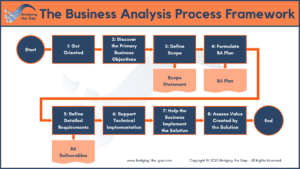 You’ll also want to have a business analysis process framework, so you can lead your clients through a process. At Bridging the Gap, we teach an 8-step business analysis process framework to being effective and successful as a business analyst.
>> Start YOUR Path to Success
 If business analysis is a career that you want to pursue, the absolute best next thing to do is to join my free Quick Start to Success Workshop. In that workshop, you will learn more about the business analyst career path as well as details about the business analysis process framework that will give you the structure that you succeed as an independent business analyst consultant.
>> Click here to join the Quick Start to Success workshop <<

Hi Laura- Agree with you not every BA role is a consultant role 🙂 also great comments on higher-value engagement. Thanks a lot.
Regards,
Akarsh
Hi Akarsh, I would agree 100% that business analyst work can be consulting work, but not every BA role is a consultant role. Domain knowledge and providing the solution approach can be ways to consult within business analysis. But so can expert facilitation skills (helping the stakeholders realize and act on ideas they would not have without your facilitation). To me, consulting is about working in a shorter-term, higher-value engagement and often this means that you are bringing expertise that the organization does not have internally.
@Laura – Great article on Business Analyst Consultant.
I would like to point out that is sometimes working as BA in a company we might end up doing a role of “BA and Consultant” together. Working as a BA with good amount of domain experience and aware of technical skills would help to create new ideas and solutions for existing stakeholders and projects itself (thus by providing end-to-end solutions; this would automatically lead to for additional revenues).
My existing work revolves around this; where i have been always able to create incremental revenues by providing creative solutions.
What’s your take on this ? Is this not a work of Business Analyst Consultant ?
Sometimes we did put forward few proposals/solutions for free for customers(wherein few worked later on for revenues and few did not)
From charging clients point of view; if Business Analyst Consultant with lesser years of experience does not know how to calculate this i think better interact with people like Managers in the organization before putting forward a proposal to clients.
Thanks for pointing me to this, Laura. It certainly helps! I’m taking the networking with people I already know approach, as they are familiar with my skills and personality.
Also thanks for opening discussions on how to charge. I have been wondering about that. I have worked as a contractor in the past. I was assuming that charging would be structured the same way – but perhaps not? Looks like there is some research to do!
Hi guys,
Read all ur comments, since i am a novice in this i don know how to comment on this.
But wanno thank this blog, which makes me to learn things.
I have question, i am working for a financial services Co. (hedge fund), as a Financial analyst, i would like to know whether there is any certification which will go with my present work.
Thanks for any replies.
Aniq, Great comments and thoughts. I agree that communication and networking are key to building a consulting practice. If people don’t know who you are or what you are up to, you are likely to miss opportunities. I like that you emphasize the depth of the connections. This is not just a numbers game. It’s not about having a lot of LinkedIn connections but not knowing anything about those people. It’s about building the foundations of strong relationships and nurturing them over time.
Laura
It comes with limitless hard work and learning to smile when the chips are down. I am constantly in touch with about 20 consulting companies all over the US and have made it a point to meet the Account Managers for all the companies. Once you have established a personal connection with recruiters and account managers, they will be try a lot harder to find a contract for you. Once I am on a contract, I make it a point to make personal connections with my co workers/managers. Remember-consultants are not on projects to make friends, but being friendly and approachable (specially for a BA), goes a long way.
Over the years, I have built strong connections with major players in the IT industry as well as with consulting companies. It has helped me a lot-since when a position opens up, I am likely be on their minds.
The key is to keep constant communication with people. Make sure people remember you, make sure you treat people with respect and make sure you make working with you a great experience-and ofcourse make sure they trust your ability as a BA.
Keep connecting with people. Trust me, in this field-it’s the key!
Sr. BSA
Tom, This is a great point. The list of prospects definitely comes first (although you may choose to start by starting to identify you prospects). Another book I find useful is Integrity Selling. Susan Penny Brown recommended it to me and it’s a great read about how to sell without being “salesy”.
Laura
I strongly suspect that unless you can generate a list of prospects for your BA Consulting you should not start off in that direction. Zig Zigler (that GREAT Business Analyst 😉 argues correctly I think that without sales prospects, you can’t sell your services/product/whatever. I got that from his Zig Ziglar on Sales (3 cd-rom set from Amazon.com).
If you are an experienced BA but totally at sea here, try this book as a possibility. “Become a Business Consultant” by Coolahan, Goulet and Archibald. It is not a great book but it does seem to be pretty good. It covers the essentials including pricing your service. It discusses general business consulting practices vs. niche practices. It is North American-centric. Its general advice should transfer anyplace but I can’t be certain. It is available in 3 formats, e-book, cd-rom and paperback. I found it worth the price even though I can’t say I have followed through on its advice. Available at: http://www.FaJob.com
@ keith : Thanks for your advice, I recently joined Computer Society of India, the Indian chapter of British Computer Association. The chapter of IIBA in India is still under approval stage, once they get approval I would join them. As for LinkedIn I am working on fine tuning my personal profile…
@ David and Laura : Thanks , I have started searching for such firms in India, although I am still skeptical whether these companies bring outsider on board, companies in India tend to setup their own centers with BAs on their payroll, I am bit inclined on starting my own Center, but still keeping my option open for job as BA in case things don’t work out…..
Nivid
Keith and David, Thanks for your great suggestions.
Nivid, I’d second David’s suggestion to look for consulting companies that might bring you on for a project. You can gain invaluable perspectives into how they get their business, offer their services, and manage the contract that will help you on your path to being an independent consultant. I know many “independents” who build strong relationships with such companies because they provide a more stable stream of work.
Laura
Consulting companies that hire BAs often do sub-contracting as well, so they could still be worth checking out. I still think it is a good step to get hired by a consulting company to get experience before going solo, so don’t discard any opportunities too quickly.
Some other ideas came to mind regarding networking.
Get active in the local and national IIBA (International Institute for Business Analysis). The organization provides a lot of practical information as well as a designation which will probably grow in demand.
Along that line, if you have a field of expertise, find out what organizations are available for you to join at the local and national level in that field. Help plan a conference or lead a workshop. You never know where such activities can lead.
Also, set up a page in LinkedIn complete with your resume. Join various groups that interest you and then be ready to either ask questions or offer answers.
@ David : Thanks a lot for your efforts, it seems I was not clear with my earlier comment…my bad…you are suggesting that I should find a job as a Business Analyst in a company, But what I am think is to be an independent BA (although now my plans are to start my own IT development center here), I am searching for consulting companies which PROVIDE PROJECTS for Business analysis or development…
just Google, I found this in a few clicks
http://jobsearch.naukri.com/job-listings-Business-Analyst-IT-opening-in-Hwadstrong-Noida-Headstrong-Noida-3-to-8-years-231109001589-
@ David : Thanks for your inputs, can you give me some suggestion as where can I search for consulting companies, such companies are rare in India…. 🙂
@ Keith : Thanks for your formula, I’ll give it a try for my next assignment…
Regarding what to charge I suggest you take your current salary give yourself a well-deserved raise of X% then figure out what that comes to on an hourly basis. Let that be your off-site rate. Then, as you apply for jobs / contracts / opportunities figure out your travel (plane, car rental, mass transit), food, and lodging expenses on a 5 day basis. Divide that by 40 (a regular work week) and add that to your off-site rate. This is your on-site rate.
Most employers are happy to have you on site especially when they can see that your onsite rate can be justified. Once you get the hang of what they want they are equally open to allowing you to work from home. At least, that has been my experience, overall.
Hi David, I think that’s a good point and a great suggestion. I had a lot of luck with recruiters but it was difficult to find work at the beginning for sure.
I think it would be tough to start on your own. I would look for a consulting company that does business analysis engagements as a source of work.
Hi Nivid,
Thanks for your comment. The short answer is it’s all about customer research. Asking others what they charge, asking recruiters what the market will bear, and asking your clients about the value of your services. What about the rest of you? How do you determine what to charge?
Laura
Ah! you made my day!! Just what I was looking for…still I want to know how do you arrive at the amount you charge to the clients for managing a project, of course it depends on the type of project but still it would be great if you provide some details…
Thanks a ton for d blog….
Nivid
Pingback: Help a BA!: How do you become a business analyst consultant? | Top Daily Articles
Pingback: Tweets that mention Help a BA!: How do you become a business analyst consultant? -- Topsy.com